Tanvi Mehta · Oct 8, 2026 · 5 min read
From Interview Chaos to Clear Insight: Turning Research Notes into a Story
Tanvi Mehta · Mar 23, 2025 · 2 min read
From Interview Chaos to Clear Insight: Turning Research Notes into a Story
Tanvi Mehta · Oct 8, 2026 · 5 min read
From Interview Chaos to Clear Insight: Turning Research Notes into a Story
Research doesn't fail during interviews. It fails between the last interview and the first slide.
Research doesn't fail during interviews. It fails between the last interview and the first slide.
Research doesn't fail during interviews. It fails between the last interview and the first slide.
You finish your 12th interview of the week. Your head is full of quotes, screen recordings, and half-remembered sighs. Then you sit down to write the report, and something frustrating happens. You forget.
You finish your 12th interview of the week. Your head is full of quotes, screen recordings, and half-remembered sighs. Then you sit down to write the report, and something frustrating happens. You forget.
You finish your 12th interview of the week. Your head is full of quotes, screen recordings, and half-remembered sighs. Then you sit down to write the report, and something frustrating happens. You forget.
Not because you weren’t listening.
Not because you weren’t listening.
Not because you weren’t listening.
Not because you didn’t take notes.
Not because you didn’t take notes.
Not because you didn’t take notes.
But because you took in too much.
But because you took in too much.
But because you took in too much.
Some insights hit hard. Some repeated. Some were fascinating but beside the point. And somewhere between interview #3 and interview #12, it all blended together. Participant #2’s sharpest moment fades, and Participant #12’s comments fill the space simply because they’re freshest.
Some insights hit hard. Some repeated. Some were fascinating but beside the point. And somewhere between interview #3 and interview #12, it all blended together. Participant #2’s sharpest moment fades, and Participant #12’s comments fill the space simply because they’re freshest.
Some insights hit hard. Some repeated. Some were fascinating but beside the point. And somewhere between interview #3 and interview #12, it all blended together. Participant #2’s sharpest moment fades, and Participant #12’s comments fill the space simply because they’re freshest.
That’s the hidden cost of qualitative research. So how do you get from raw interviews to a clear, convincing story without losing what matters?
That’s the hidden cost of qualitative research. So how do you get from raw interviews to a clear, convincing story without losing what matters?
That’s the hidden cost of qualitative research. So how do you get from raw interviews to a clear, convincing story without losing what matters?
Here’s the framework I use.
Here’s the framework I use.
Here’s the framework I use.
The 5-Stage Framework: From Notes to Narrative
The 5-Stage Framework: From Notes to Narrative
The 5-Stage Framework: From Notes to Narrative
Stage 1: Capture with Intent (During and Right After Interviews)
Stage 1: Capture with Intent (During and Right After Interviews)
Stage 1: Capture with Intent (During and Right After Interviews)
Most researchers only write down answers. That’s the mistake.
Most researchers only write down answers. That’s the mistake.
Most researchers only write down answers. That’s the mistake.
Instead, split your notes into three live sections:
Instead, split your notes into three live sections:
Instead, split your notes into three live sections:
Research goals
Research goals
Research goals
• What are we trying to learn?
• What are we trying to learn?
• What are we trying to learn?
• What decision will this inform?
• What decision will this inform?
• What decision will this inform?
What I keep hearing
What I keep hearing
What I keep hearing
• Pain points that come up again and again
• Pain points that come up again and again
• Pain points that come up again and again
• Emotional reactions, like a sigh, a laugh, or a long pause
• Emotional reactions, like a sigh, a laugh, or a long pause
• Emotional reactions, like a sigh, a laugh, or a long pause
• Moments of confusion
• Moments of confusion
• Moments of confusion
Surprises
Surprises
Surprises
• Anything you didn’t expect
• Anything you didn’t expect
• Anything you didn’t expect
• Contradictions (“I never use filters,” right before they use one)
• Contradictions (“I never use filters,” right before they use one)
• Contradictions (“I never use filters,” right before they use one)
• Strong opinions
• Strong opinions
• Strong opinions
Then block 10 minutes right after each session to fill gaps while the conversation is still fresh. Wait until Friday, and it’s gone.
Then block 10 minutes right after each session to fill gaps while the conversation is still fresh. Wait until Friday, and it’s gone.
Then block 10 minutes right after each session to fill gaps while the conversation is still fresh. Wait until Friday, and it’s gone.
This early sorting keeps your notes from turning into a shapeless pile of transcripts. You’re already analyzing while you collect.
This early sorting keeps your notes from turning into a shapeless pile of transcripts. You’re already analyzing while you collect.
This early sorting keeps your notes from turning into a shapeless pile of transcripts. You’re already analyzing while you collect.
Stage 2: Participant-Level Findings (Zoomed In)
Stage 2: Participant-Level Findings (Zoomed In)
Stage 2: Participant-Level Findings (Zoomed In)
Before you look across users, look at each one closely.
Before you look across users, look at each one closely.
Before you look across users, look at each one closely.
For every participant, write a short summary covering:, split your notes into three live sections:
For every participant, write a short summary covering:, split your notes into three live sections:
For every participant, write a short summary covering:, split your notes into three live sections:
• What works for them
• What works for them
• What works for them
• What doesn’t
• What doesn’t
• What doesn’t
• Their mental model
• Their mental model
• Their mental model
• Their biggest friction point
• Their biggest friction point
• Their biggest friction point
• 1 to 3 key quotes, in their exact words
• 1 to 3 key quotes, in their exact words
• 1 to 3 key quotes, in their exact words
Think of it as a one-page insight sheet per person. Use their words, not yours. If someone calls your dashboard “the wall of numbers,” that phrase matters.
Think of it as a one-page insight sheet per person. Use their words, not yours. If someone calls your dashboard “the wall of numbers,” that phrase matters.
Think of it as a one-page insight sheet per person. Use their words, not yours. If someone calls your dashboard “the wall of numbers,” that phrase matters.
Don’t skip this step. Skip it, and you’ll jump straight to generalizations and lose the nuance. This is where you separate signal from noise, one person at a time.
Don’t skip this step. Skip it, and you’ll jump straight to generalizations and lose the nuance. This is where you separate signal from noise, one person at a time.
Don’t skip this step. Skip it, and you’ll jump straight to generalizations and lose the nuance. This is where you separate signal from noise, one person at a time.
Stage 3: Pattern Mapping (From Notes to Findings)
Stage 3: Pattern Mapping (From Notes to Findings)
Stage 3: Pattern Mapping (From Notes to Findings)
Now zoom out.
Now zoom out.
Now zoom out.
Go across all your participant sheets and:
Go across all your participant sheets and:
Go across all your participant sheets and:
• Highlight findings that repeat
• Highlight findings that repeat
• Highlight findings that repeat
• Count them. How many people mentioned this?
• Count them. How many people mentioned this?
• Count them. How many people mentioned this?
• Sort them into:
• Sort them into:
• Sort them into:
Repeated patterns
Repeated patterns
Repeated patterns
Edge cases
Edge cases
Edge cases
Outliers
Outliers
Outliers
This is where most researchers get overwhelmed. The trick is simple. Don’t jump to insights yet. Stay with findings.
This is where most researchers get overwhelmed. The trick is simple. Don’t jump to insights yet. Stay with findings.
This is where most researchers get overwhelmed. The trick is simple. Don’t jump to insights yet. Stay with findings.
Write statements like these:
Write statements like these:
Write statements like these:
• 7/10 participants struggled to find X.
• 7/10 participants struggled to find X.
• 7/10 participants struggled to find X.
• 5/10 participants rely on workaround Y.
• 5/10 participants rely on workaround Y.
• 5/10 participants rely on workaround Y.
• 3/10 participants misread feature Z.
• 3/10 participants misread feature Z.
• 3/10 participants misread feature Z.
Those numbers do double duty. They keep you honest now, and they give stakeholders something solid later. “Some users struggled” starts a debate. “7 out of 10 users struggled” ends it.
Those numbers do double duty. They keep you honest now, and they give stakeholders something solid later. “Some users struggled” starts a debate. “7 out of 10 users struggled” ends it.
Those numbers do double duty. They keep you honest now, and they give stakeholders something solid later. “Some users struggled” starts a debate. “7 out of 10 users struggled” ends it.
And don’t toss the outliers. Sometimes one participant spots the edge case that breaks everything, like the person who exports 50,000 rows when everyone else exports 200.
And don’t toss the outliers. Sometimes one participant spots the edge case that breaks everything, like the person who exports 50,000 rows when everyone else exports 200.
And don’t toss the outliers. Sometimes one participant spots the edge case that breaks everything, like the person who exports 50,000 rows when everyone else exports 200.
Stage 4: Turn Findings into Insights
Stage 4: Turn Findings into Insights
Stage 4: Turn Findings into Insights
This is where research turns into strategy.
This is where research turns into strategy.
This is where research turns into strategy.
Finding: 7/10 participants struggled to find the export feature.
Finding: 7/10 participants struggled to find the export feature.
Finding: 7/10 participants struggled to find the export feature.
Insight: Users expect to export at the moment they finish a task, not dig for it in settings.
Insight: Users expect to export at the moment they finish a task, not dig for it in settings.
Insight: Users expect to export at the moment they finish a task, not dig for it in settings.
Findings describe behavior. Insights explain mental models.
Findings describe behavior. Insights explain mental models.
Findings describe behavior. Insights explain mental models.
To get from one to the other, ask:
To get from one to the other, ask:
To get from one to the other, ask:
• Why is this happening?
• Why is this happening?
• Why is this happening?
• What belief or expectation is driving it?
• What belief or expectation is driving it?
• What belief or expectation is driving it?
• What tension does it reveal?
• What tension does it reveal?
• What tension does it reveal?
A good insight should feel like a key that unlocks something bigger than the moment that sparked it.
A good insight should feel like a key that unlocks something bigger than the moment that sparked it.
A good insight should feel like a key that unlocks something bigger than the moment that sparked it.
Stage 5: Build the Story (From Insights to Narrative)
Stage 5: Build the Story (From Insights to Narrative)
Stage 5: Build the Story (From Insights to Narrative)
Now you shift from analysis to storytelling.
Now you shift from analysis to storytelling.
Now you shift from analysis to storytelling.
Group related insights into themes. For example:
Group related insights into themes. For example:
Group related insights into themes. For example:
Theme 1: Users Put Flow Ahead of Control
Theme 1: Users Put Flow Ahead of Control
Theme 1: Users Put Flow Ahead of Control
• Insight A
• Insight A
• Insight A
• Insight B
• Insight B
• Insight B
• Supporting quotes
• Supporting quotes
• Mental model diagram
• Mental model diagram
• Mental model diagram
Theme 2: Visibility Builds Trust
Theme 2: Visibility Builds Trust
Theme 2: Visibility Builds Trust
• Insight C
• Insight C
• Insight C
• Insight D
• Insight D
• Insight D
• Supporting quotes
• Supporting quotes
You’re not listing what users said anymore. You’re making an argument.
You’re not listing what users said anymore. You’re making an argument.
You’re not listing what users said anymore. You’re making an argument.
A strong report usually has:
A strong report usually has:
A strong report usually has:
• 3 to 5 core themes
• 3 to 5 core themes
• Several insights supporting each theme
• Several insights supporting each theme
• Findings and quotes behind every insight
• Findings and quotes behind every insight
Lead with the themes that matter most to the business. That’s your deck. That’s your story.
Lead with the themes that matter most to the business. That’s your deck. That’s your story.
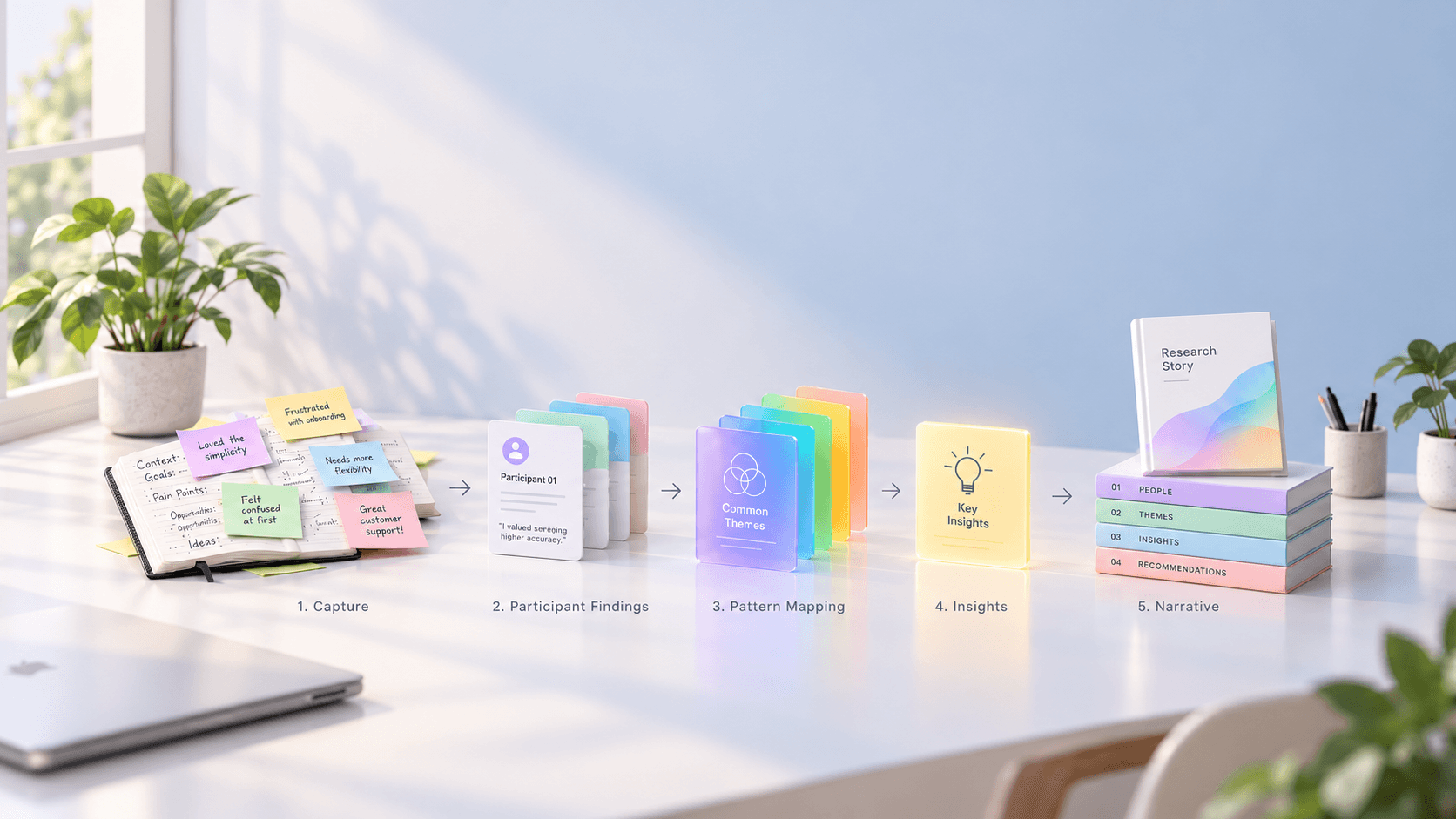
The Zoom Framework: An Easy Way to Remember It
The Zoom Framework: An Easy Way to Remember It
You’re always moving between levels:
You’re always moving between levels:
Raw notes (zoomed in)
Raw notes (zoomed in)
Participant findings
Participant findings
Cross-participant patterns
Cross-participant patterns
Insights
Insights
Themes and narrative (zoomed out)
Themes and narrative (zoomed out)
Most researchers get stuck at one end. Some stay too zoomed in, and the report turns into a data dump. Others jump too far out and end up with vague insights like “users want simplicity.”
Most researchers get stuck at one end. Some stay too zoomed in, and the report turns into a data dump. Others jump too far out and end up with vague insights like “users want simplicity.”
The craft is moving between levels on purpose.
The craft is moving between levels on purpose.